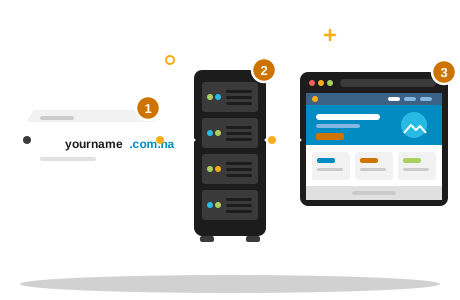
- The domain is your address, the hosting is the plot your website stands on, and the website is the house you build there.
- DNS records connect the three, and they also tell the world where to deliver your email.
- You pay for the domain and the hosting every year; the website is mostly a one-off build plus upkeep.
- Always register the domain in your own business's name, whoever builds the website.
Domain, hosting, website: three words that often appear on the same invoice and are easy to mix up. When it comes to domain vs hosting, the short answer is this: the domain is your address on the internet, the hosting is the server space where your website and email live, and the website is what your visitors actually see.
Knowing the difference helps you compare quotes, avoid paying twice and stay in control of your online presence. Here is how the pieces fit together.
The Simple Analogy: Address, Plot and House
Think of your online presence as a business premises:
- The domain is your street address, such as yourbusiness.com.na. It is how people find you, but on its own it is just a name.
- The hosting is the plot of land: space on a server that is connected to the internet day and night.
- The website is the building on that plot: the pages, text, photos and features your visitors use.
A street address without a plot leads nowhere, and a building without an address is impossible to find. You need all three, and they need to be connected correctly.
What Is a Domain Name?
A domain name is the human-friendly address that replaces the numeric IP address of a server. You register it through a domain registrar, usually for a year at a time, and renew it every year for as long as you want to use it. Strictly speaking you never own a domain outright: you hold the right to use it while it is registered to you.
The ending of the domain is its extension. Namibian businesses usually choose .com.na, while international businesses often use .com or .africa. If you are deciding which one to pick, our guide on how to register a .na domain compares the options and their prices.
What Is Web Hosting?
Web hosting is the service that stores your website's files, databases and often your email on a server, and delivers them to anyone who visits. A good hosting provider also looks after security updates, backups and the SSL certificate that puts the padlock in your visitors' browsers.
There are different types of hosting for different needs. Shared hosting is the affordable choice for most company websites; a VPS gives busy websites, online shops and web applications their own guaranteed resources. Our comparison of shared hosting vs VPS helps you choose.
Domain vs Hosting vs Website at a Glance
| Domain | Hosting | Website | |
|---|---|---|---|
| What it is | Your address | Server space | Your pages and content |
| Example | yourbusiness.com.na | A shared server or VPS | Home, services, contact page |
| Provided by | A domain registrar | A hosting provider | You or a web designer |
| How you pay | Every year | Monthly or yearly | Mostly once, plus upkeep |
| If it lapses | Website and email stop | Website and email go offline | Content becomes outdated |
Many providers sell the three together, which is convenient. It is still worth knowing which part you are paying for, because each one can be moved separately.
How DNS Connects Your Domain and Hosting
The link between your domain and your hosting is the Domain Name System (DNS), the internet's address book. For every domain it stores a handful of records:
- Name servers say which DNS service holds the records for your domain.
- A and AAAA records point your domain to the IP address of the server that hosts your website.
- MX records tell other mail servers where to deliver email for your domain.
- TXT records prove domain ownership to services such as Google and publish email security settings (SPF, DKIM and DMARC).
Because each service has its own records, your website and your email do not have to run on the same server. The DNS simply points each part to the right destination.
When you change a DNS record, it can take a few hours before every network sees the new value. That is why moving a website or email service is best planned rather than done in a hurry.
Where Does Email Fit In?
A professional address such as info@yourbusiness.com.na needs three things: the domain, an email hosting service that stores the mailboxes, and the MX records that connect them. Email hosting is often included with web hosting packages, so your mailboxes run on the same managed servers as your website and stay under your control.
Our step-by-step guide to creating a professional email address walks you through it.
What Each Part Costs per Year
To give you a realistic reference, here are our own published prices:
- Domain: registering a .com.na domain costs N$ 1 040; international .com, .net and .org domains start from N$ 350 per year (all excluding VAT).
- Website with hosting: our website packages combine the build, a year of hosting and support, from N$ 2 990 per year including VAT on a yourname.business.na address. The Business package at N$ 4 890 per year includes your own .com domain and three email addresses.
- Custom work: online shops, booking systems and larger websites are quoted individually.
You can compare everything that is included on our website packages page.
Common Mistakes to Avoid
- The domain is registered in someone else's name. If a former web designer or employee registered it in their own name, moving away can become difficult. Make sure your business is the registrant.
- The renewal email goes to an old address. An expired domain takes your website and email offline. Keep your contact details current and use automatic renewal.
- Nobody has the logins. Keep the access details for your registrar, hosting and DNS in a safe, shared place, such as a password manager.
- Paying for hosting twice. If your website package already includes hosting, you do not need a separate hosting plan for the same site.
- Judging by the first-year price. Some offers are cheap in year one and expensive at renewal. Compare what you will pay every year.
- No backups. Ask how often your hosting is backed up and how quickly a backup can be restored.