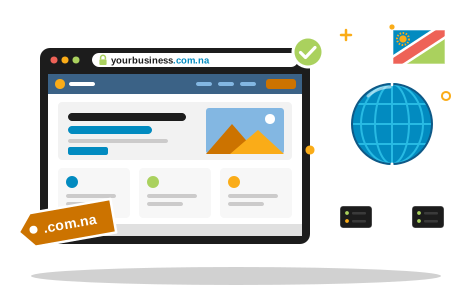
- Most Namibian businesses choose a .com.na domain: affordable, instantly recognised as Namibian and easy to register.
- A first-level .na domain (yourname.na) is a premium product and costs several times more than .com.na.
- Registrations run through accredited registrars; the .na registry itself does not deal with applicants.
- Register the domain in your own business's name and make sure it renews on time every year.
If your customers are in Namibia, a Namibian web address tells them at a glance that they are dealing with a local business. .na domain registration is straightforward once you know which extension to choose, what it costs and who you register it through.
This guide explains the difference between .na and .com.na, shows real prices in Namibian dollars, walks you through the registration step by step and covers what happens afterwards: renewals, transfers and connecting your website and email.
The Namibian Domain Extensions Explained
Every Namibian domain ends in .na, the country code top-level domain (ccTLD) for Namibia. There are two ways to register one:
- Directly under .na (the second level), as in yourbusiness.na. Short and memorable, and priced as a premium product.
- Under an established category (the third level), as in yourbusiness.com.na. This is what most Namibian companies use.
The most common categories and who typically uses them:
| Extension | Typically used by |
|---|---|
| .com.na | Companies and other commercial businesses |
| .co.na | Also commercial, an alternative to .com.na |
| .org.na | Non-profit organisations, associations and churches |
| .net.na | Internet, network and technology businesses |
| .edu.na | Schools, colleges and training institutions |
| .na | Anyone who wants the shortest possible Namibian address |
These are conventions rather than hard rules. Your registrar checks the current requirements for the extension you choose before submitting your application.
.na vs .com.na: Which Should You Choose?
For most businesses, .com.na is the sensible choice. It is the extension Namibians know best, it is a fraction of the price of a first-level .na domain and it works just as well for your website and email. Search engines treat both the same way: each tells Google that your site is aimed at Namibia.
A first-level .na domain makes sense if a very short address is part of your brand, or if the .com.na version of your name is already taken. Because it is a premium product, budget for the higher price every year, not just in the first year.
If you also sell to customers outside Namibia, consider a .com or .africa address alongside your .com.na domain, with one pointing to the other so visitors always end up in the same place.
What a .na Domain Costs in 2026
These are our current registration prices for Namibian domains, excluding VAT. They apply to Namibian companies and residents:
| Extension | Registration |
|---|---|
| .com.na | N$ 1 040 |
| .co.na | N$ 1 290 |
| .org.na | N$ 1 030 |
| .net.na | N$ 1 095 |
| .edu.na | N$ 1 000 |
| .na | N$ 5 550 |
International domains such as .com, .net and .org start from N$ 350 per year.
Why does a .na domain cost more than a .com?
Wholesale prices for Namibian domains depend on two things: whether the name is registered directly under .na (the premium level) or under a category such as .com.na, and whether the registrant is Namibian or foreign. Foreign registrants pay considerably more: Namibian registrar Namhost has reported that a foreign .com.na registration costs almost ten times the local price. That is why Namibian domains look expensive next to a .com, and why the first-level .na sits in a different price bracket altogether.
You can see every extension we offer on our domain registration page.
Who Can Register a Namibian Domain?
The .na domain is managed by the Namibian Network Information Centre (NA-NiC), which has appointed Omadhina Internet Services to operate the register. NA-NiC does not deal with applicants directly. Every registration, renewal and change goes through an accredited registrar, and Namibian and foreign registrars can both be accredited.
The registry distinguishes between Namibian and foreign registrants, mainly in price. If you are a foreign company, ask your registrar for the applicable price before you apply.
A few rules apply to everyone who holds a .na domain:
- Accurate details. The registrant information must be true, complete and kept up to date.
- No bad-faith registrations. NA-NiC's acceptable use policy prohibits using a name that is confusingly similar to someone else's registered trade mark or business name in bad faith. Disputes are handled through the complaint resolution service of the Council of Country Code Administrators (CoCCA).
- Clear contact details for online sellers. If you sell goods or services through a .na domain, the policy requires clear and accurate contact details on the website.
How to Register a .na Domain, Step by Step
- Choose the name. Shortlist two or three options in case your first choice is taken (see the tips below).
- Check availability. Use your registrar's domain search, or simply send us the names you have in mind.
- Pick the extension. .com.na for most businesses, .org.na for non-profits, .edu.na for schools, or the premium .na.
- Provide the registrant details. Register the domain in the name of your business, with a contact email address that someone reads.
- Decide where the domain points. The domain needs DNS: the settings that send visitors to your website and email to your mailboxes. If your registrar also hosts your website, this is done for you.
- Pay and confirm. Your registrar submits the application and tells you once the domain is active.
- Set up your website and email. DNS changes can take a few hours to reach every network. After that your new address is live.
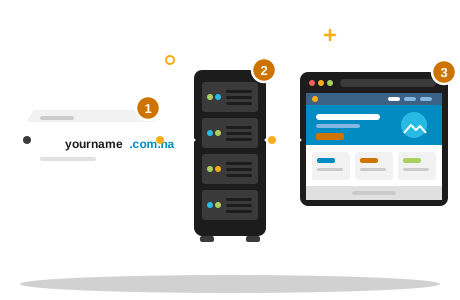
Not sure how the domain, the hosting and the website relate to each other? Our guide on domain vs hosting vs website explains it in plain language.
Tips for Choosing a Good Domain Name
- Keep it short. Every extra letter is another chance for a typing mistake.
- Make it easy to say. Read it out over the phone. If you have to spell it, simplify it.
- Match your business name. Customers will guess your address from your name, so make that guess correct.
- Avoid hyphens and numbers unless they are part of your brand.
- Respect trade marks. A name that copies another business can be suspended after a complaint.
- Protect variations. If budget allows, register common misspellings or a second extension and point them to your main domain.
Renewals, Transfers and DNS
Renewals. Domains are registered for a year at a time. If a renewal is missed, your website and email stop working, and the name can eventually be released for someone else to register. Use automatic renewal, or make sure the renewal reminders reach an inbox that is checked.
Transfers. Your domain is not tied to one provider. NA-NiC's registrar agreement requires registrars to let customers change registrars without interrupting the use of their domain. If you want to move an existing .na domain to us, we handle the transfer on request.
DNS. Once registered, the domain's DNS records do the real work:
- A/AAAA records point visitors to your website's server.
- MX records tell other mail servers where to deliver your email.
- TXT records prove ownership and protect your email from spoofing with SPF, DKIM and DMARC. Our article on why emails go to spam explains what they do.
With the domain in place, the natural next step is a professional email address such as info@yourbusiness.com.na.