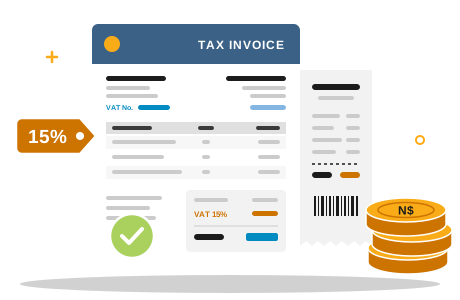
- Namibia's standard VAT rate is 15%, and registration is compulsory once your taxable supplies exceed N$ 1 000 000 in any 12 months (since 1 October 2024).
- A valid tax invoice needs seven particulars, including the words “tax invoice”, your VAT registration number, a unique serial number and the VAT shown separately.
- Namibia has no separate abridged tax invoice: instead, cash sales of up to N$ 1 000 need no tax invoice at all.
- Correct a mistake with a tax credit note or tax debit note, never by editing the original, and keep your VAT records for at least five years.
Once your business is registered for VAT in Namibia, every invoice you send is also a tax document. Your VAT-registered customers can only claim back the VAT you charge them if your tax invoice shows the details the law requires, and NamRA can ask to see copies of your invoices for years afterwards.
This guide explains the current VAT rate, who must register and when, exactly what a valid Namibian tax invoice must contain, how credit and debit notes work, how long to keep your records and the mistakes to avoid. It is based on the Value-Added Tax Act 10 of 2000 as amended up to the Value-Added Tax Amendment Act 5 of 2024, and on NamRA publications current in November 2026. At the end you will find a checklist and an example invoice layout.
General information, not tax advice: confirm your own situation with NamRA or a registered accountant.
VAT in Namibia at a Glance
These are the figures every small business owner should know, with the section of the VAT Act each one comes from:
| Rule | Current figure | VAT Act |
|---|---|---|
| Standard VAT rate | 15% | Section 6(1) |
| Compulsory registration | Taxable supplies above N$ 1 000 000 in any 12 months | Section 15(1), since 1 October 2024 |
| Voluntary registration | Possible below the threshold, where taxable supplies are expected to exceed N$ 200 000 in 12 months | Section 15(4) |
| Deadline to apply once liable | 21 days | Section 15(6) |
| Tax period for most businesses | Two calendar months | Section 23(2)(b) |
| Return and payment due | By the 25th day of the month after the tax period ends | Sections 24(1) and 30(1) |
| Cash sales that need no tax invoice | Up to N$ 1 000 | Section 21(2), since 1 October 2024 |
| Keeping records | At least five years after the end of the tax period | Section 48(5) |
The two figures marked “since 1 October 2024” were changed by the Value-Added Tax Amendment Act 5 of 2024 (Government Gazette 8443 of 16 September 2024), which came into force on 1 October 2024 under Government Notice 281 of 2024. Before that, registration became compulsory above N$ 500 000 and the cash-sale limit was N$ 100. Some older brochures and websites still quote the old figures, so check the date of anything you read.
Not every sale carries 15%: some supplies are zero-rated (0%, for example goods exported from Namibia, listed in Schedule III of the Act) and some are exempt (listed in Schedule IV). If you apply the zero rate, keep documentary proof that you were entitled to it.
Who Must Register for VAT, and When
Registration is compulsory when the value of your taxable supplies (excluding VAT) exceeded N$ 1 000 000 in the past 12 months, or when there are reasonable grounds to expect it to exceed N$ 1 000 000 in the coming 12 months. NamRA's own registration guide, updated in February 2026, confirms the N$ 1 000 000 figure.
- It is any 12 months, not your financial year. Check your rolling turnover every month as you approach the threshold.
- Apply within 21 days of becoming liable. If you do not, the Act imposes a penalty of double the output tax payable from the date you became liable until you apply (section 66).
- Connected businesses can be counted together. NamRA may take a connected person's supplies into account (section 15(2)).
- One-off events do not count. You do not become liable only because you sold capital goods you were replacing, or because the business is closing or permanently shrinking (section 15(3)).
Voluntary registration
Smaller businesses may apply to register voluntarily. Section 15(4) links this to taxable supplies expected to exceed N$ 200 000 in 12 months, and NamRA may refuse an applicant without a fixed place of business, proper accounting records or a good compliance record. Voluntary registrants normally file every six months (section 23(2)(c)). NamRA's registration form also warns that you cannot cancel because of reduced turnover until two years after registration took effect, so register voluntarily only when it clearly helps, for example when most of your customers are VAT-registered businesses that want to claim input tax.
How to apply
NamRA first registers you as a taxpayer, online through its ITAS portal or at a NamRA office, and issues a Taxpayer Identification Number (TIN). VAT is then added as a tax type linked to that TIN. The VAT registration form asks for your registered and trading name, place of business, TIN, main activity, annual or expected taxable turnover and a Namibian bank account confirmed by your bank. Starting from scratch? Our guide on how to register a business in Namibia covers the steps before VAT.
Until NamRA has registered you, do not charge VAT. A person who is not registered but represents that VAT is included in a price can be assessed for it (section 25(1)(d)).
What a Valid Tax Invoice Must Contain
Paragraph 1 of Schedule VI to the VAT Act lists the particulars a tax invoice must contain, “except as the Commissioner may otherwise allow”. There are seven:
| Required particular | What it means in practice |
|---|---|
| 1. The words “tax invoice” | In a prominent place, usually as the document title. |
| 2. Your name, address and VAT registration number | Of the business making the supply, as registered with NamRA. |
| 3. The recipient's name and address | The customer you are supplying. The Act does not require the customer's VAT number, although many businesses add it. |
| 4. An individualised serial number and the date of issue | Use one unbroken sequence and never reuse a number. |
| 5. A description of the goods or services | “Website maintenance, October 2026”, not just “Services”. |
| 6. The quantity or volume supplied | Units, hours, kilograms or litres, as appropriate. |
| 7. The amounts | The total VAT charged, the value of the supply (excluding VAT) and the total including VAT. |
Under section 21(1), a registered supplier must provide a tax invoice when the customer asks for one. In practice it is simplest to issue a full tax invoice for every sale on account, because your VAT-registered customers need it: without a valid tax invoice in hand when they file their return, they cannot deduct the input tax (section 18(2)).
Section 21 adds three more rules:
- One supply, one tax invoice. You may issue only one tax invoice for each taxable supply. If a customer loses theirs, you may give them a copy clearly marked “copy”.
- Customers can ask later. A registered customer who did not receive a tax invoice can request one in writing within 60 days after the supply, and you must provide it within 14 days.
- Self-billing needs approval. A customer may issue the tax invoice on your behalf only with NamRA's prior written approval (section 21(9)).
Full vs Abridged Tax Invoices: The N$ 1 000 Rule
If you deal with South African suppliers, you may know the “abridged” tax invoice with fewer details for smaller amounts. Namibia's VAT Act has no abridged tax invoice. There is one set of particulars, listed above, for every tax invoice.
Instead, section 21(2) says a registered supplier does not have to provide a tax invoice at all if the total consideration for the supply is paid in cash and does not exceed N$ 1 000. Until 30 September 2024 that limit was N$ 100.
For a shop, café or market stall, a till slip is therefore fine for small cash sales. For larger sales, or where you are unsure whether a payment counts as cash, issue a full tax invoice. And a VAT-registered customer who buys for their business still needs one to claim input tax, so give it to them when they ask.
Tax Credit Notes and Tax Debit Notes
Once a tax invoice has been issued, you do not change or delete it. If the VAT on it becomes wrong because something changed after the sale, you issue a separate document. Section 20(1) lists the triggers:
- the supply is cancelled;
- the nature of the supply changes fundamentally, changing how it is taxed;
- the agreed price changes, for example because you give a discount;
- the goods or services, or part of them, are returned.
If the invoice showed too much VAT, you issue a tax credit note. If it showed too little, you issue a tax debit note (section 22). Paragraphs 2 and 3 of Schedule VI require each note to show:
- the words “tax credit note” or “tax debit note” in a prominent place;
- your name, address and VAT registration number;
- the customer's name and address;
- the date the note was issued;
- the value shown on the original tax invoice, the correct value, the difference between the two and the VAT on that difference;
- a brief explanation of why the note is being issued;
- enough information to identify the original supply, such as the original invoice number and date.
As with invoices, only one note may be issued for each correction, and a lost note may be replaced by a copy marked “copy”. You adjust your output tax in the tax period in which the event happened, and a registered customer accounts for the difference in the period in which they receive the note (section 20).
Your VAT Registration Number
Your VAT registration number must appear on every tax invoice, credit note and debit note. The VAT Act does not prescribe a format for it: section 52 simply lets NamRA require the number it issued to you on returns and other documents.
Since NamRA introduced its ITAS system, every taxpayer is identified by a Taxpayer Identification Number (TIN), which NamRA's payment guide describes as an 8-digit number, and VAT is registered as a tax type linked to it. Print your VAT registration number exactly as it appears in your NamRA registration documents.
Never use another business's number, even while your own registration is pending. Knowingly using a false VAT registration number, including someone else's, is an offence with a fine of up to N$ 8 000 or up to two years' imprisonment (section 61). If a supplier's number looks wrong, ask for their registration confirmation before you claim the VAT.
How to Calculate VAT, With Examples
There are only two calculations you need:
- Adding VAT to a price that excludes VAT: VAT = price × 15%, and the total = price × 1.15. Example: N$ 1 000.00 + N$ 150.00 VAT = N$ 1 150.00.
- Finding the VAT inside a price that includes VAT: the Act calls this the “tax fraction”, r ÷ (100 + r), which at 15% is 15/115. Example: N$ 1 150.00 × 15/115 = N$ 150.00 VAT, leaving N$ 1 000.00 excluding VAT.
A common slip is to take 15% of a VAT-inclusive price. On N$ 1 150.00 that gives N$ 172.50, which is wrong: the VAT included is N$ 150.00. Our free Namibia VAT calculator does both calculations for you, in either direction.
Prices must include VAT
Section 77 of the Act treats any price charged by a registered person as including VAT, whether or not you added it. Prices you advertise or quote must include VAT and say so. You may quote a price excluding VAT only if you also show the VAT and the VAT-inclusive price with equal prominence. If you quote “N$ 1 000” and forget the VAT, the law assumes the N$ 1 000 already includes it, and the VAT comes out of your margin.
How Long to Keep Invoices and Records
Section 48 of the VAT Act requires every registered person to keep, in English and at their place of business in Namibia:
- the originals of all tax invoices, credit notes and debit notes you receive;
- copies of all tax invoices, credit notes and debit notes you issue;
- customs documents for your imports and exports;
- your accounting records, and any other records NamRA determines.
These records must be kept for at least five years after the end of the tax period they relate to, and produced when a NamRA officer asks for them (section 48(5)). NamRA repeated the five-year rule for VAT, income tax and customs records in a public notice of 15 July 2026, adding that it may still ask for older documents that support a recently submitted return.
Records may be kept on a computer system outside Namibia only if it is a centralised system linked to your Namibian place of business and you can give NamRA print-outs or access within 24 hours of a written request (section 48(3)). The penalty for failing to keep proper records is N$ 3 000 for each day the failure continues (section 69).
Common Tax Invoice Mistakes to Avoid
- Leaving out the words “tax invoice”. A document headed only “Invoice” does not meet Schedule VI.
- Gaps or duplicates in the numbering, usually from invoices typed by hand in a word processor.
- Vague descriptions such as “Services rendered”.
- Not showing the VAT separately from the values excluding and including VAT.
- Charging VAT before you are registered. NamRA can assess you for it.
- Editing or re-issuing an invoice already sent instead of issuing a credit or debit note, or issuing two tax invoices for one supply.
- Quoting prices without VAT and without showing the VAT-inclusive price with equal prominence.
- Relying on outdated figures such as the old N$ 500 000 threshold or the N$ 100 cash-sale limit.
- Claiming input tax without a valid tax invoice from your supplier when you file your return.
- Filing or paying late. A late return costs N$ 100 for each day it is outstanding (section 67). Late payment attracts a penalty of 10% of the unpaid tax for each month or part of a month, capped at the tax itself, plus interest (sections 68 and 53).
Knowingly issuing a materially wrong or incomplete tax invoice, credit note or debit note is an offence, with a fine of up to N$ 8 000 or up to two years' imprisonment (section 55).
Checklist and Example Tax Invoice Layout
Here is how the required particulars fit together on a simple tax invoice. The business, customer and figures are invented for illustration:
| Invoice element | Example |
|---|---|
| Title | TAX INVOICE |
| Supplier | Example Office Supplies CC, 12 Example Street, Windhoek |
| Supplier VAT registration number | Your number, exactly as issued by NamRA |
| Customer | Sample Trading (Pty) Ltd, 4 Sample Road, Swakopmund |
| Invoice number and date | INV-2026-0147, 3 November 2026 |
| Line 1 | Printer toner cartridge, 2 units × N$ 450.00 = N$ 900.00 |
| Line 2 | On-site printer servicing, 2 hours × N$ 300.00 = N$ 600.00 |
| Total excluding VAT | N$ 1 500.00 |
| VAT at 15% | N$ 225.00 |
| Total including VAT | N$ 1 725.00 |
Payment terms and banking details are not required by the Act, but your customers will expect them.
Tax invoice checklist
- The words “tax invoice” in a prominent place
- Your registered name, address and VAT registration number
- The customer's name and address
- A unique, sequential invoice number and the date of issue
- A clear description and the quantity of each item
- The value excluding VAT, the VAT charged and the total including VAT
- VAT calculated at the correct rate, or the zero rate applied only where the Act allows it
- A copy filed where you can find it for at least five years
- Credit and debit notes, not edits, for any later correction
Let Your Invoicing Software Do the Work
Most of these mistakes happen when invoices are typed by hand: numbers are skipped, VAT is miscalculated and copies end up scattered across laptops and inboxes. If that sounds familiar, our article on the signs your business has outgrown spreadsheets is worth a read.
Whichever invoicing system you choose, check that it numbers invoices automatically, shows the VAT separately, can issue credit notes and keeps every document you send in one secure place.
Our own Sales & Project Manager™ is web-based business management software for small and medium enterprises in any industry, hosted for you by PHOENIX. It combines a complete invoicing solution with proposals and quotations, a customer relationship database, expenses, payments and financial reports, and contract, file and project management. It sends automated emails and SMS with tracking, and your customers can download their invoices and quotations from their own client area. Send them from a professional email address on your own domain and your invoices look as trustworthy as they are correct.